There’s more than one reason why people love brands like P&G, Warby Parker, and Apple.
But, can you guess what these three brands have in common?
They all solve consumer problems.
P&G invented a better way to mop with the Swiffer.
Warby Parker created affordable, stylish glasses.
Steve Jobs of Apple introduced the iPhone as a “smarter mobile device.”
These brands manufactured their own value propositions by solving problems. They are creative problem solvers.
In the spirit of these creative problem solvers, I’m going to analyze the concept of designing a value proposition by thinking outside the box with problem-solving.
But before we dig in, we first need to understand how we got to this point.
We used to live in a world where “marketing strategies” boiled down to bombarding audiences with messages about how your product was the best.
If that seems a bit simplistic to you, that’s because it was.
And that begs an obvious question: Did it actually work?
It absolutely did.
Why did it work? Well, it was largely because of the media channels that dominated consumer attention.
Television and radio promotion had a massive impact on the effectiveness of a brand’s marketing efforts. Television advertising alone accounted for 2% of the US GDP beyond 1950.
And if I had to point to one thing that made these kinds of marketing strategies so successful, it would be the culture of the traditional consumer.
Passive media channels were a staple of that culture. Television and radio were constantly interrupting the user experience to throw in some ads.
With no other options available, the traditional consumer got used to the idea of repetitive ads being a part of daily life.
But all of that changed once the Internet started gaining traction.
Embrace the nature of digital media
The marketing rules of engagement changed suddenly and completely.
The experience went from passive to interactive. The average person gained the ability to pick and choose what marketing content they consumed with a simple little search engine:

This transition would end up determining the future of digital marketing strategies and fundamentally changing the way businesses communicate with consumers.
And it’s not that surprising when you stop and think about it.
In a world where ads were the status quo, consumers didn’t have much of a choice.
But the moment consumers became aware of a life without ads was the moment traditional marketing began its quiet death.
It’s how we ended up here today with 615 million devices that use adblock and 59% of millennials skipping ads on YouTube.
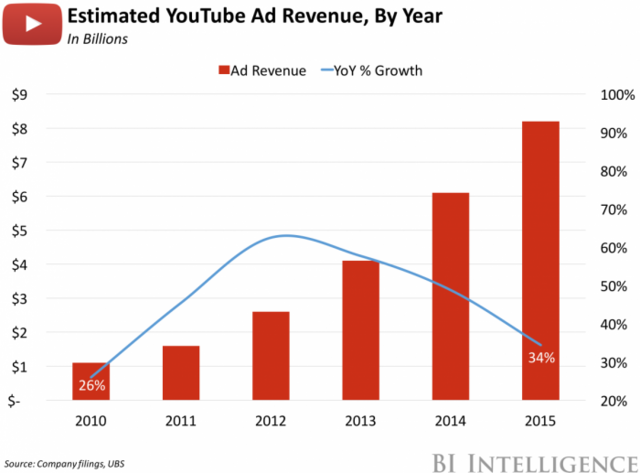
With their 92 million consumers, Spotify has a large usership that doesn’t even mind paying extra for ad-free streaming services.

Of course, all of this speaks to a bigger issue.
To put it bluntly, the modern consumer plays by a different set of rules.
They reject the idea that a jingle or a self-promotional TV spot should be enough to earn their business.
If you want their attention, you’ll need to give them something that traditional marketing strategies can’t: real value.
Real value is about problem-solving
At this point, some small business owners might say, “Isn’t my product/service value enough?”
Well, the answer is yes and no.
Real value isn’t about how often you self-promote. It’s about problem-solving.
Having a valuable product or service is important, and it always will be. There’s no doubt about that.
Buffer didn’t become Buffer just because they had a nice interface. They built a brand around offering a social media solution for consumers looking for an easier way to share content.

There’s a reason Buffer has 82,156 paying customers. They have a 19-person advocacy team that helps their customer solve problems.
In this highly competitive, ever-changing digital media landscape, you need to stand out before and after the sale.
One of the easiest ways to convey the problem you are solving is with content marketing.

Particularly on social media, content is the key to developing a relationship with consumers.
Audiences are in constant need of new content that’s worth their time.
And when you’re trying to solve problems with your content, there’s one approach that just about every small business can get behind:
Educational content.
It’s the cornerstone of most successful brand blogs, and that’s for good reasons.
Sites like NerdWallet pride themselves on their ability to provide users with this kind of content.
NerdWallet ranks for more than 1.3 million keywords in the personal finance advice industry.

Here’s what NerdWallet’s VP of Content, Maggie Leung, explained during an interview:
“At NerdWallet we see content people as an investment.”
But getting here isn’t easy.
To begin content ideation to achieve NerdWallet-status, you have to understand your audience.
And, to better understand your audience, you’ll need to use tools and strategies to help generate content ideas.
Your content isn’t just convenient. It’s the backbone of online authority, and it gives you the opportunity to connect with consumers.
And that leads us to the most important reason to focus on educational content:
It effectively sells the brand without selling a product.
Think about the American Express OPEN forum.
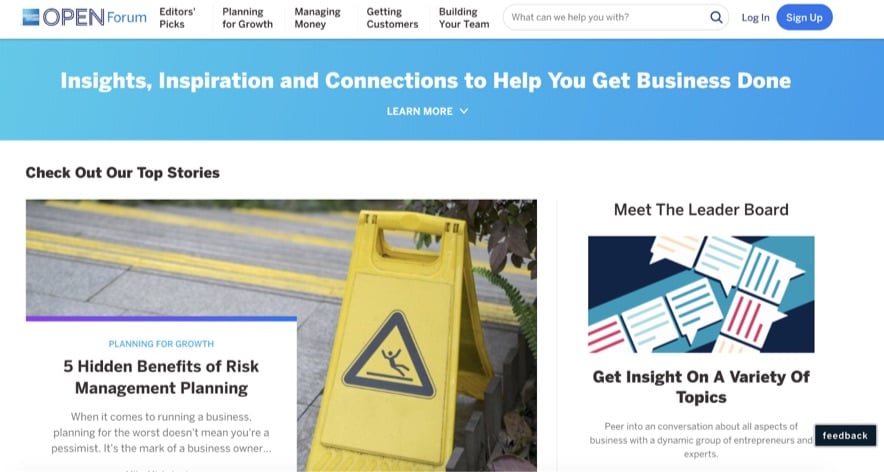
Here’s what Courtney Colwell, Director of Content Marketing at American Express OPEN Forum, told Entrepreneur about the forum:
“It all stems from our mission of helping these businesses do more business. With our small business customers, their growth fuels ours. It’s a win-win if we can help them succeed.”
They have 109.9 million cards in circulation and a valuation of around $18.3 billion. They don’t need to worry about selling their brand. This forum does it for them.
Or, take Irene Pavico, a videographer and post-production professional, for example.
Irene created a course called THE iPhone Film School to help people get started with video marketing that only uses an iPhone.

She explains that those who are just starting out with making videos may not want to invest in an expensive camera. So, she wants to show you how to start off with the technology that everyone has: an iPhone.
Irene’s approach shows that she understands her audience. She breaks down pain points they have when getting started with video marketing and then solves them.
As far as educational content goes, there are typically two categories that you can focus on.
The most common one that businesses tend to tackle is the tangible solutions category.
Tangible solutions are all about the here and now.
No matter what industry your business is in, your audience likely has plenty of issues and questions that they need help with.
That’s why consumers are 131% more likely to buy from a brand after they consume educational content.
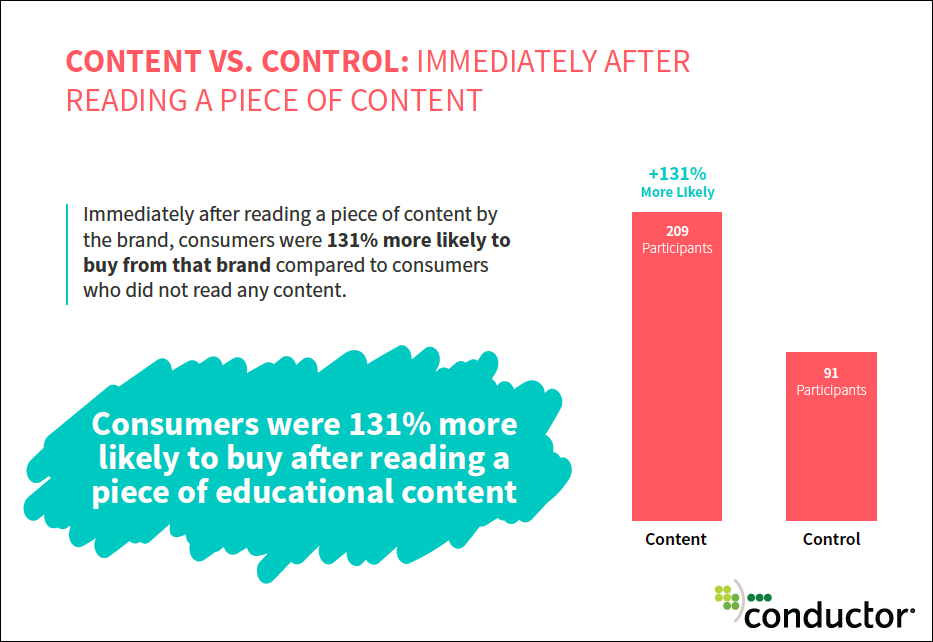
It may not be glamorous, but consumers need and appreciate actionable advice that helps them deal with these immediate problems.
Bux implemented a knowledge base, and it helped them improve their first call resolution by 18%.
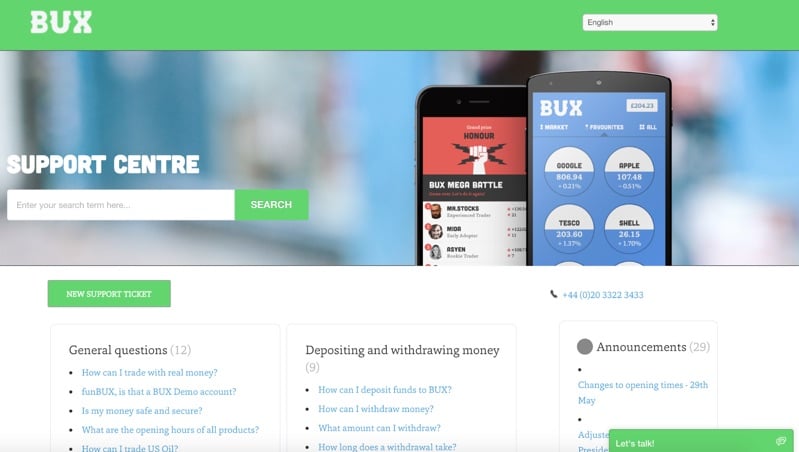
It’s easy to follow, it doesn’t ask for anything from the reader, and it’s objectively valuable.
But that’s just the tip of the iceberg.
While actionable, tangible solutions are important, there’s more to value-driven content than the immediate future.
Can you focus on solving specific problems for your audience? You absolutely can.
Is that all your content can do for them? It certainly isn’t.
The flip side of the coin is thought leadership.
If tangible solutions are all about the short-term, then thought leadership is all about the long-term.
This is the kind of content that you’ll see industry leaders like Gary Vaynerchuk post:

Gary is a thought leader that connects with his fans to inspire loyalty. He’s worth more than $160 million, and he employs more than 700 people.
When you’re creating thought leadership content, you’re not just looking to solve someone’s problem today. You’re looking to address the source of that problem altogether.
Just take a look at how brands are becoming thought leaders by addressing changes.
SEMrush does a weekly chat on Twitter where they talk about the latest SEO trends.

Or, consider Content Marketing Institute’s webinars.
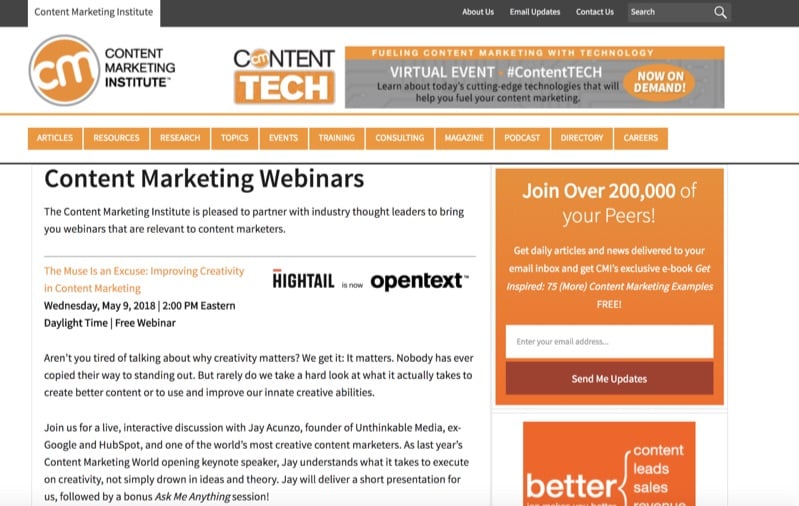
With thought leadership, you layer educational content with a breakdown of marketing principles that small business owners should be adopting.
And don’t think that this is exclusive to digital media. Any business can benefit from thought leadership.
According to CEO Omar Sayyed, the tie company Ties.com saw a 30% growth in revenue over the last five years by earning trust with digital content.
Here is an example of one of their top-performing pieces of content on how to tie a tie.
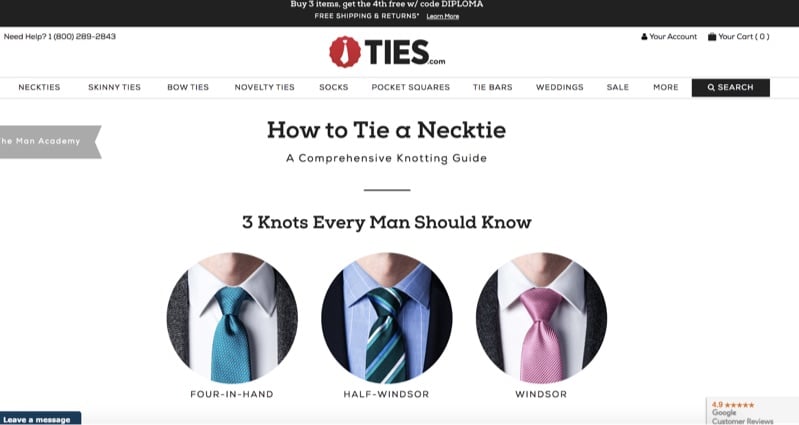
Thought leadership doesn’t just pay attention to symptoms. It identifies the illness and helps your audience cure itself.
As you can probably imagine, this is the most difficult kind of content to create. It requires a strong understanding of industry-wide issues and, more importantly, how to solve them. But if you do it well, the results will be well worth the effort.
Of course, there’s more to problem-solving than just crafting blog posts.
You could create e-books and give them away in exchange for email newsletter sign-ups like Mike Gingerich does.
Or, you can build brand authority through your email list with help from your blog at the same time. After all, email marketing has a median ROI of 122%, which puts other marketing formats to shame.
Or, you can treat social media like an extension of customer support by focusing on one-to-one interactions and addressing customer issues directly.
KLM, Europe’s airline industry leader, used Facebook Messenger to increase customer interactions by 40%.

At the end of the day, your marketing strategy exists for one reason:
To convince people that they should do business with you.
And if you want to showcase just how valuable you are, you have to solve consumer problems more efficiently and more consistently than your competition.
Focus on understanding your audience
At this point, it’s pretty clear that treating marketing as an opportunity for problem-solving appeals to the needs of the modern consumer.
So far, I’ve only covered what that looks like in a general sense.
If you really want to get your hands dirty, you need to see what it looks like in action.
That’s why I’m going to take a look at three brands that have managed to create compelling, valuable marketing content.
More specifically, I’m going to analyze how their particular audiences dictated their marketing strategies.
Why? Because understanding your audience’s needs guarantees that your marketing content will be meaningful, impactful, and valuable to them.
Here’s how Seth Godin puts it:
“Trying to appeal to everyone is almost sure to fail, for the simple reason that everyone wants something different!”
So, how do you do this? My advice is to start by creating buyer personas.
You’ve probably already created them for your product or service. Now’s your chance to expand on them.
If you haven’t updated your buyer personas in a long time, you can use this template from Xtensio:
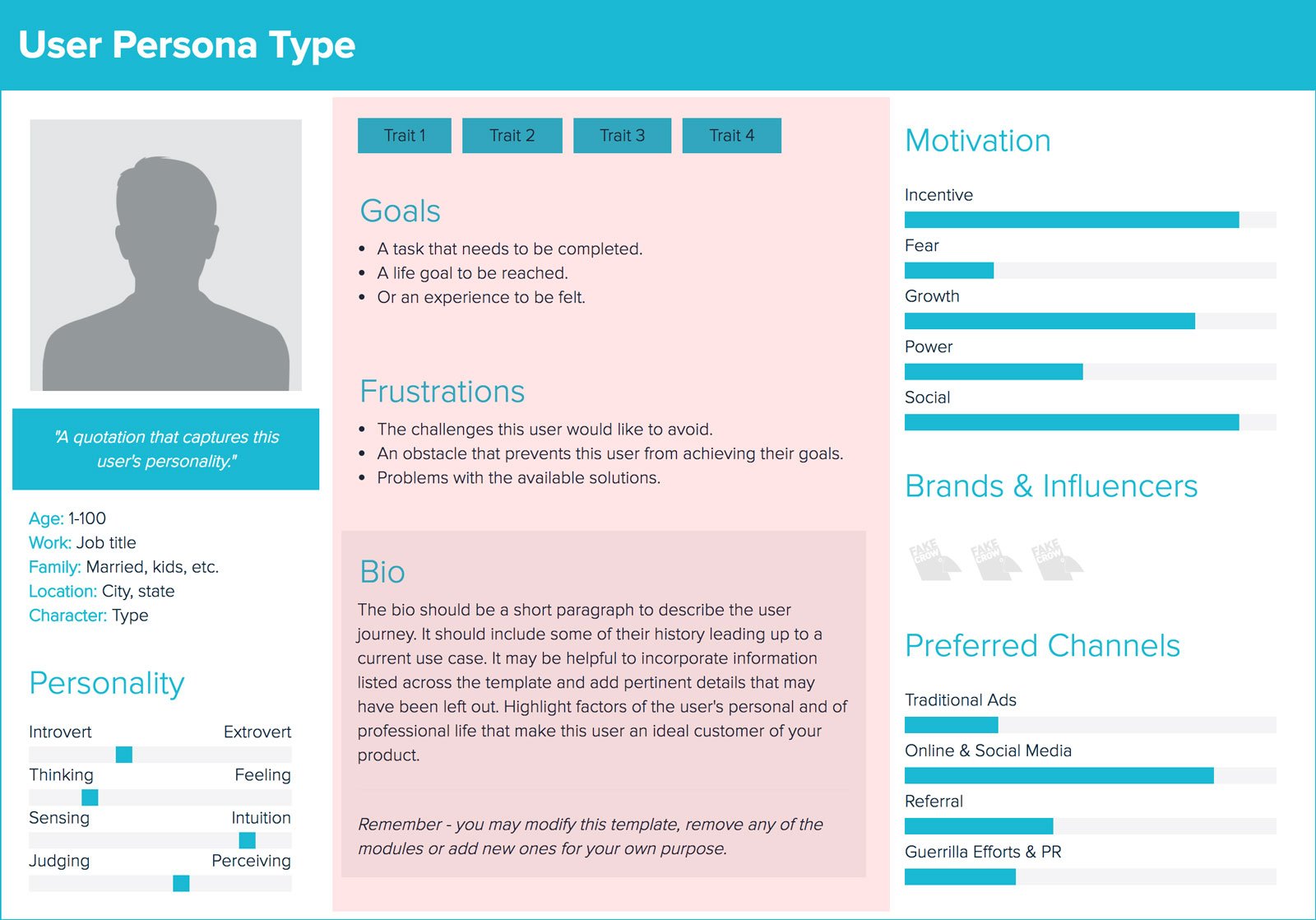
Overall, there’s a pretty clear correlation between your attention to customers and the success of your business.
In fact, one study found that 65% of businesses that exceeded their lead and revenue goals had updated their buyer personas within the previous six months.
The more information you have, the more you’ll be in tune with the problems of your customers. So, don’t be afraid to ask questions.
What social media platforms do they like to engage with you on?
Who are the industry influencers that they actively pay attention to?
What problem does everyone in your audience struggle with on a regular basis?
General digital media marketing principles are important, but they aren’t worth much if you can’t apply them to your unique marketing situation.
Businesses that have used problem-solving effectively
In this next section, we’re going to look at some marketing strategies from successful businesses. But as we do so, keep in mind that the goal isn’t just to copy them.
Instead, use them as a reference point for your particular marketing strategy.
No matter what tactics you choose, your content still needs to appeal specifically to your audience and provide them with value at every opportunity.
With that in mind, let’s take a look at some businesses that have found success with problem-solving.
Mint
If you’re not familiar with Mint, here’s what their elevator pitch might sound like:
Struggling to keep your finances in order? Use our service to stay organized, get back on track, or start saving up enough cash to buy a house.

After the company started, it grew rapidly. They managed to acquire 1.5 million users in their first two years.
But marketing a service like this is actually a bit tricky.
After all, who couldn’t use more help keeping their finances in order? How do you make a marketing strategy that targets most of the population?
Mint came up with a solution: Market to their two types of users.
The first group is already relatively financial literate. They’re looking to build wealth.
The second group is trying to budget as efficiently as possible. They’re more interested in keeping their bank account in the green than anything else.
How can I tell that these are their two types of users?
Taking one look at their official blog tells me everything I need to know.
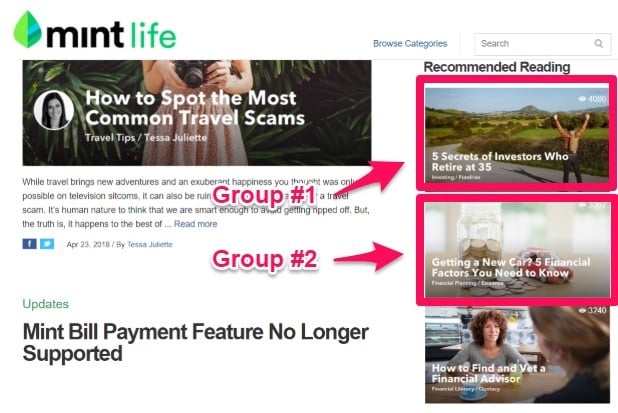
These blog posts target the extremes of their buyer personas, and Mint appeals to both equally.
With most of their audience likely falling somewhere between those two extremes, it’s fair to say that Mint managed to effectively cover their bases without diluting their message.
As for the content itself, it focuses on tangible, actionable advice.
And that makes perfect sense when you consider the audience they’re speaking to. People looking for concrete financial advice won’t appreciate vague tips.
Someone who’s struggling to manage their finances wants a roadmap to get back on track, not a study on the growth of a Fortune 500 company:

Mint’s content is a mix of blog posts, interviews, and infographics that target younger audiences who are beginning to manage their money.
Largely because of their blog posts, their SEO strategy drove 20% of their total site traffic.
Mint drives thousands of visitors from their budgeting templates and budgeting spreadsheets alone.

So, what’s the lesson?
You shouldn’t just make your content relevant to your audience’s problems in general. To make it as effective as possible, you have to be sensitive to their particular situation.
Slack

If you’ve spent any amount of time in the tech startup scene, you’ve probably heard people raving about Slack.
And it’s worth all the hype it’s receiving.
When you need a messaging app that prioritizes productivity and ease of use, it’s hard to find anything better (especially if you’re working with a remote team).
This is why they’re worth about $5.1 billion.
With all the tools and integrations they offer, it’s easy to see why their taglines are “be less busy” and “where work happens.”
In fact, instead of focusing on content marketing, Slack aims to rank for keywords related to their integrations.
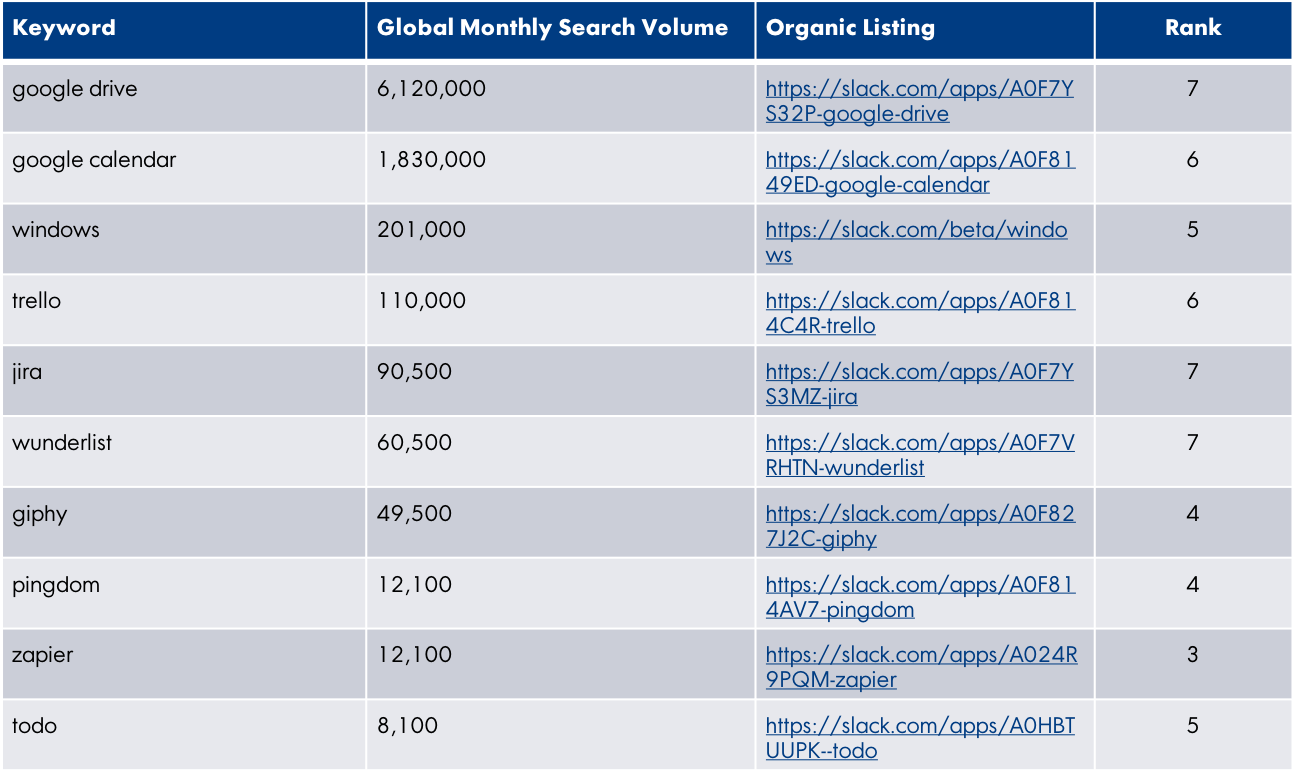
With that in mind, you can already start to see what the Slack audience looks like.
You can picture a startup C-level executive looking for a credible solution to her workplace productivity issues.
Slack’s onboarding process is really where the magic happens. Slack has a deep insight into what their audience needs and they create a unique approach to onboarding.

Right off the bat, you’ll see content that they’ve designed to improve overall workplace efficiency.
Slack even has articles for advice on naming channels and email templates for introducing Slack.

Beyond that, Slack also opts to provide value with updates about their own product.

And, admin users can opt-in for weekly summaries of activities.

They also offer instant notifications.

Slack also keeps a blog with product updates, integration announcements, and tips for improving productivity.
The design their blog posts to ensure that the audience can use Slack to the best of their ability.

For them, it’s not about selling the product as much as it is about improving the user experience.
So, what’s the moral of the story?
Support consumers whether or not they’ve spent their hard-earned money on you. Always provide solutions to their problems as they develop.
Dollar Shave Club
At this point, you’re probably tired of hearing about how impressive the marketing strategies of Dollar Shave Club are.

But acquiring 12,000 customers in their first two days is a little too impressive to ignore.
There are plenty of digital media marketing experts who are fascinated with this brand, and I’m one of them.
Why? Well, mostly because it’s a success story that proves that sound marketing tactics, regardless of the audience in question, can help your business excel.
To put it simply, Dollar Shave Club excels in their ability to create a unique consumer experience in an industry that desperately needs it.
And their audience, which is primarily men looking for a stylish, playful, and witty brand, can benefit from the content on the Dollar Shave Club blog.
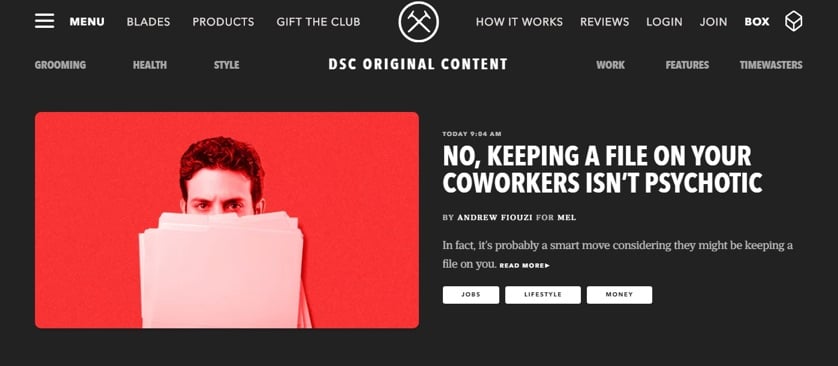
The articles have clear, eye-catching headlines, and they’re full of value — all while maintaining that unique DSC brand voice.
They even send personalized emails based on previous purchase history.
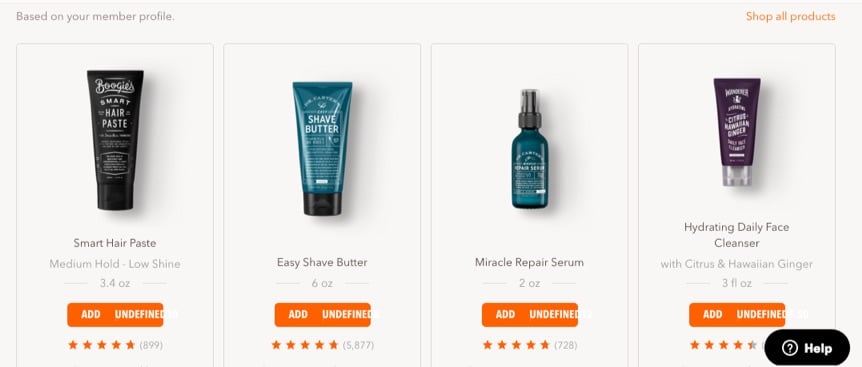
If you take nothing else from Dollar Shave Club’s example, remember that your ability to create compelling customer experiences is just as important as the advice you give in your content.
It’s not just what you say. It’s how you say it.
Comments
Post a Comment